Harnessing Generative AI for Developers: From Code Completion to Project Scaffolding
Explore how generative AI is transforming the developer workflow, offering powerful assistance from intelligent code completion and refactoring to automating boilerplate and even scaffolding entire projects. This guide delves into practical applications of AI tools like GitHub Copilot and ChatGPT, showcasing how they boost productivity, reduce development time, and enhance code quality for modern software engineers.
Harnessing Generative AI for Developers: From Code Completion to Project Scaffolding
The landscape of software development is undergoing a profound transformation, thanks to the rapid advancements in Generative AI. Once considered a futuristic concept, AI is now an indispensable assistant for developers, streamlining workflows, accelerating development cycles, and even enhancing code quality. This article explores how generative AI tools are empowering developers, from providing intelligent code suggestions to automating the foundational setup of new projects.
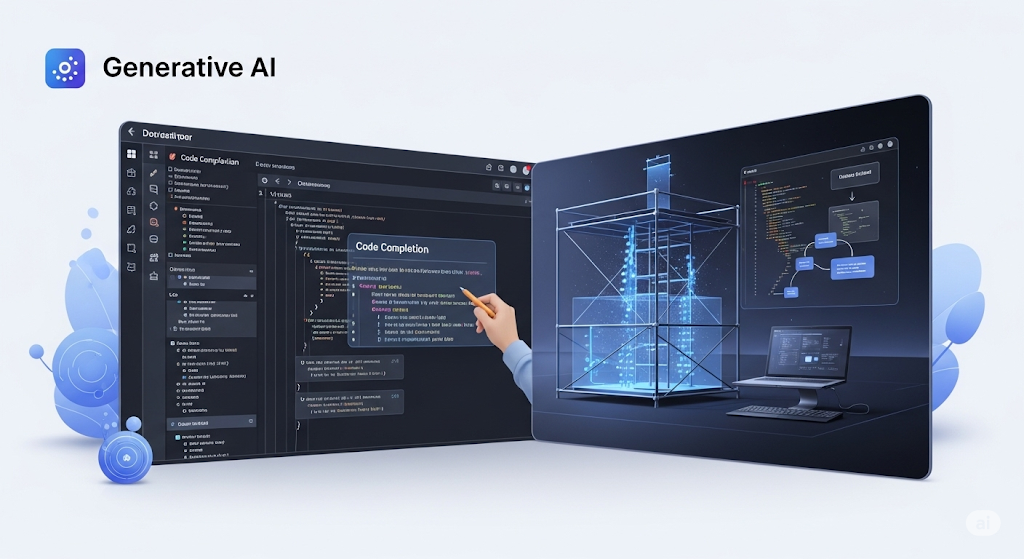
The Evolution of Developer Tools: From IDEs to AI Pair Programmers
For decades, Integrated Development Environments (IDEs) have been central to a developer's toolkit, offering features like syntax highlighting, debugging, and basic code completion. While incredibly powerful, these tools primarily react to the code being written. Generative AI, however, takes a proactive approach, understanding context, predicting intent, and generating entirely new code or structures.
This shift marks the emergence of "AI pair programmers" – intelligent agents that collaborate with developers, offering real-time assistance and significantly boosting productivity.
Key Applications of Generative AI in Development
Generative AI's utility for developers extends across various stages of the software development lifecycle. Let's delve into some of the most impactful applications.
1. Intelligent Code Completion and Suggestions
Perhaps the most visible and widely adopted application of generative AI is intelligent code completion. Tools powered by large language models (LLMs) can suggest not just the next variable or function name, but entire lines or blocks of code based on the current context, comments, and even surrounding files.
Example: GitHub Copilot in Action
// Function to fetch user by ID from an API
async function getUserById(id: string) {
  const response = await fetch(`/api/users/${id}`);
  if (!response.ok) {
    throw new Error(`HTTP error! status: ${response.status}`);
  }
  const data = await response.json();
  return data;
}
Key Benefits:
- Speed: Drastically reduces typing, especially for boilerplate code.
- Accuracy: Often suggests idiomatic and correct code patterns.
- Learning: Exposes developers to new APIs, libraries, and best practices.
2. Code Generation from Natural Language
Beyond completion, generative AI can translate natural language descriptions directly into executable code. This is particularly useful for generating complex algorithms, data structures, or even small utility functions.
Example: Using ChatGPT to Generate a Sorting Algorithm
You could simply ask: "Write a Python function to implement quicksort."
def quicksort(arr):
    if len(arr) <= 1:
        return arr
    pivot = arr[len(arr) // 2]
    left = [x for x in arr if x < pivot]
    middle = [x for x in arr if x == pivot]
    right = [x for x in arr if x > pivot]
    return quicksort(left) + middle + quicksort(right)
Example usage:
my_list = [3, 6, 8, 10, 1, 2, 1]
sorted_list = quicksort(my_list)
print(sorted_list)
Applications:
- Rapid Prototyping: Quickly generate proof-of-concept code.
- Learning New Languages/APIs: Get working examples without deep dives into documentation.
- Reducing Boilerplate: Generate repetitive code blocks quickly.
3. Code Refactoring and Optimization Suggestions
Generative AI isn't just about creating new code; it can also analyze existing code for potential improvements. It can suggest refactorings to enhance readability, identify performance bottlenecks, or recommend more efficient algorithms.
Example: Refactoring a redundant check
// Original code
function processData(data) {
  if (data === null || data === undefined || data.length === 0) {
    return null;
  }
  // ... process data
}

// AI suggested refactoring:
function processData(data) {
  if (!data || data.length === 0) { // More concise check
    return null;
  }
  // ... process data
}
4. Test Case Generation
Writing comprehensive unit tests is crucial but often time-consuming. AI can analyze your functions and generate relevant test cases, including edge cases, significantly improving code coverage.
5. Documentation Generation
Keeping documentation up-to-date is a common challenge. Generative AI can automatically generate documentation for functions, classes, and modules based on their code and comments, saving developers valuable time.
6. Project Scaffolding and Boilerplate Automation
One of the most powerful and time-saving applications of generative AI is in project scaffolding. Instead of manually setting up project structures, configuration files, and basic components, AI can automate this process.
Scenario: Setting up a new Next.js project with authentication and a database
Imagine you want to start a new Next.js project with:
- TypeScript
- Tailwind CSS
- NextAuth.js for authentication
- Prisma ORM connected to PostgreSQL
Instead of manually installing dependencies, configuring files, and setting up initial routes, you could theoretically use a sophisticated AI tool or even a series of detailed prompts to an LLM like ChatGPT to:
- Generate package.json with all necessary dependencies.
- Create initial folder structure (pages, components, lib, api).
- Set up next.config.js, tailwind.config.js, tsconfig.json.
- Generate basic authentication files ([...nextauth].ts).
- Create initial Prisma schema (schema.prisma) and migration commands.
- Provide a basic _app.tsx and index.tsx with layout and session context.
While fully automated, production-ready scaffolding is still evolving, current LLMs can already provide excellent starting points and code snippets for each of these steps, significantly accelerating the initial setup phase.
graph TD
    A[Developer Idea] --> B{AI Tool / LLM Prompt};
    B --> C[Generate Package.json];
    B --> D[Generate Folder Structure];
    B --> E[Generate Configuration Files];
    B --> F[Generate Basic Components/Auth];
    B --> G[Generate Database Schema];
    C & D & E & F & G --> H[Ready-to-Start Project];
    H --> I[Developer Iterates & Builds];

    style A fill:#10B981,stroke:#10B981,stroke-width:2px;
    style B fill:#3B82F6,stroke:#3B82F6,stroke-width:2px;
    style H fill:#EF4444,stroke:#EF4444,stroke-width:2px;
Challenges and Considerations
While generative AI offers immense benefits, it's crucial to be aware of its limitations and best practices:
- Accuracy: AI-generated code is not always perfect and may contain bugs or security vulnerabilities. Always review and test generated code thoroughly.
- Context Understanding: AI still struggles with highly complex or novel problems that lack extensive training data.
- Over-reliance: Developers should not become overly reliant on AI, as it can hinder problem-solving skills and understanding of core concepts.
- Security & Licensing: Be mindful of generating code that might inadvertently infringe on licenses or introduce security risks if not properly vetted.